10 Sep 2021
// Samsung SW 기출문제
#include <iostream>
#include <vector>
#include <utility>
#include <stack>

using namespace std;

int N, M;
int lab[9][9] = {-1};
int visited[9][9] = {-1};

int dfs(int i, int j) {

}

int main() {
    cin >> N >> M;
    stack<pair<int,int>> list;
    for (int i=0; i<N; i++) {
        for (int j=0; j<M; j++) {
            cin >> lab[i][j];
            visited[i][j] = 0;
            if (lab[i][j] == 2) {
                pair<int,int> virus = make_pair(i,j);
                list.push_back(virus);
            }
        }
    }
    int size = list.size();
    for (int i=0; i<size; i++) {
        dfs(list.top().first, list.top().second());
        list.pop();
    }

}
09 Sep 2021
지난번에 틀렸던 LCS 문제를 다시 풀어봤다… 데이터 규모가 커지면 저장되는 메모리 위치도 중요하다는 점을 깨달았다. 이 부분을 정리해두면 좋을 것 같다
#include <bits/stdc++.h>

using namespace std;

char st1[1001], st2[1001];
int sub[1001][1001];

int max(int a, int b) {
    return (a>b) ? a : b;
}

int lcs(char* st1, char* st2, int st1Len, int st2Len) {
    for (int i=0; i<=st1Len; i++) {
        for (int j=0; j<=st2Len; j++) {
            if (i == 0 || j == 0)
                sub[i][j] = 0;

            else if (st1[i-1] == st2[j-1])
                sub[i][j] = sub[i-1][j-1] + 1;

            else
                sub[i][j] = max(sub[i-1][j], sub[i][j-1]);
        }
    }
    return sub[st1Len][st2Len];
}

int main() {
    ios::sync_with_stdio(false);
    cin.tie(NULL); cout.tie(NULL);

    cin >> st1 >> st2;

    cout << lcs(st1, st2, strlen(st1), strlen(st2)); // string은 str.length() / char[]는 strlen(str)
    return 0;
}

// 전역변수는 메모리 힙 영역에, 지역변수는 스택 영역에 저장되기 때문입니다 int 100만개짜리 배열이면 4MB인데 보통 스택의 크기를 초과하게 됩니다

07 Sep 2021
class를 이용한 그래프 BFS DFS 큐 스택 리스트 back iterate 소트 정신 없다…😵🤯 조만간 BFS DFS 마스터 하는 걸로 목표!! 💪🏼
#include <iostream>
#include <list>
#include <vector>
#include <stack>
#include <algorithm>
#include <queue>

using namespace std;

class Graph {
    int V;
    list<int> *adj;
    public:
        Graph(int V);
        void addEdge(int v, int w);
        void DFS(int s);
        void BFS(int s);
};

Graph::Graph(int V) {
    this->V = V;
    adj = new list<int>[V+1];
}

void Graph::addEdge(int v, int w) {
    // adj[v].push_back(w);
    adj[v].push_front(w);
    adj[w].push_front(v);
    adj[v].sort(std::greater<int>()); // descending sort
    adj[w].sort(std::greater<int>());
}

void Graph::DFS(int s) {
    vector<bool> visited(V+1, false);
    stack<int> stack;
    stack.push(s);

    while (!stack.empty()) {
        int top = stack.top(); // TOP == S
        stack.pop();

        if (!visited[top]) {
            cout << top << " ";
            visited[top] = true;
        }

        for (auto i = adj[top].begin(); i != adj[top].end(); ++i) {
            if (!visited[*i])
                stack.push(*i);
        }
    }
}

void Graph::BFS(int s) {
    vector<bool> visited(V+1, false);
    queue<int> queue;
    visited[s] = true;
    queue.push(s);

    while (!queue.empty()) {
        int front = queue.front(); // FRONT == S
        cout << front << " ";
        queue.pop();

        for (auto i = adj[front].end(); i-- != adj[front].begin();) { // reverse iterator
            if (!visited[*i]) {
                visited[*i] = true;
                queue.push(*i);
            }
        }
    }
}

int main() {
    ios::sync_with_stdio(false);
    cin.tie(NULL); cout.tie(NULL);

    int N, M, V; // N : 정점, Vertex M: 간선, Edge
    cin >> N >> M >> V;

    Graph graph(N);
    int a, b;
    for (int i=0; i<M; i++) {
        cin >> a >> b;
        graph.addEdge(a, b);
    }

    graph.DFS(V);
    cout << "\n";
    graph.BFS(V);
}

06 Sep 2021
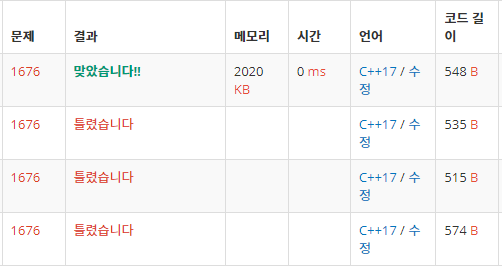
멍청하게 값 범위가 500인데 팩토리얼 일일이 다 구해서 풀려고 했던 나… 조금 더 수학적으로 접근해야했다…(인터넷 참고 ㅎㅎ)
#include <iostream>

using namespace std;

int main() {
    ios::sync_with_stdio(false);
    cin.tie(NULL); cout.tie(NULL);

    int N;
    int ans = 0;
    int arr[501];
    cin >> N;

    for (int i=1; i<=N; i++) {
        int count = 0;
        int temp = i;

        while(true) {
            if (temp % 5 == 0) {
                count++;
                temp = temp / 5;
            }
            else break;
        }
        arr[i] = count;
    }
    for (int i=1; i<=N; i++) ans = ans + arr[i];
    cout << ans << endl;
}
03 Sep 2021
#include <iostream>

using namespace std;

int arr[9] = {0,};
bool visited[9] = {0,};

void dfs(int a, int b, int n, int m) {
    if (b == m) {
        for(int i = 0; i < m; i++)
            cout << arr[i] << ' ';
        cout << '\n';
        return;
    }
    for (int i = a; i <= n; i++) {
        visited[i] = true;
        arr[b] = i;
        dfs(i,b+1);
        visited[i] = false;
    }
}

int main() {
    ios::sync_with_stdio(false);
    cin.tie(NULL); cout.tie(NULL);
    int n, m;
    cin >> n >> m;
    dfs(1,0,n,m);
}
